Highlights
- Cekura and Netra both simulate callers, score calls on the audio, and monitor live calls. The real difference is what each covers beyond the call.
- Cekura goes wide inside the call, with more voice platforms, more channels and ready-made infrastructure tests.
- Netra tests and traces voice agents, then follows the agent behind the call: its prompts, its intents, its tools and its cost per customer.
- If your stack is voice-only on Retell, ElevenLabs or SIP, start with Cekura. If voice is one part of a larger AI product, Netra is the more complete Cekura alternative.
Your voice agent is live. Cekura, or a tool like it, is catching broken calls before customers do. Then the questions move upstream.
Which prompt version caused this? Why are calls about billing suddenly taking twice as long? Which customer is driving half the model spend? And what about the chat agent the team shipped last month?
That's usually when teams start looking at Cekura alternatives. This Cekura vs Netra comparison puts the two side by side, so you can decide which fits the way your team works.
How we compared.
We're the Netra team, so we've worked to keep this fair. Every Cekura claim links to Cekura's own website or docs, checked on 22 October 2026. Netra claims come from Netra's documentation and website. Spot something out of date? Tell us and we'll fix it.
What Are Cekura and Netra?
Cekura calls itself "the reliability layer for voice agents". It tests voice and chat agents with simulated conversations, monitors production calls, and runs red teaming and load tests. It's a Y Combinator company focused on conversational AI.
Netra is an AI observability, evaluation and simulation platform for AI agents. It added voice simulation and call tracing to a platform that already traces, evaluates and monitors text agents. It's built by KeyValue, whose team has shipped more than 25 AI agents to production.
Put simply, Cekura starts from the call. Netra starts from the agent, and the call is one place that agent lives.
Why Do Teams Look for Cekura Alternatives?
Rarely because Cekura is weak at voice QA. More often, the team's needs have outgrown the call. They run text agents as well as voice agents and want one platform for both. They need to version and roll back prompts, not just test them. They want to know which customers drive cost, for pricing or SLAs. Some prefer a flat monthly plan to per-minute billing, or need an EU data region without an enterprise contract.
Teams comparing Cekura competitors usually start with exactly these questions.
How Do Cekura and Netra Compare at a Glance?
| Area | Cekura | Netra |
|---|---|---|
| Focus | Voice and chat agent QA and monitoring | Reliability for text and voice agents |
| Voice platforms | Retell, Vapi, ElevenLabs, LiveKit, Pipecat, SIP; Twilio and Plivo | LiveKit, Vapi |
| Other channels | Chat, WhatsApp, SMS during calls | Text agents on 14 LLM providers and 12+ frameworks |
| Simulated callers | ✓Accent, noise, pace, emotion, interruptions | ✓Accent, language, pace, clarity, mood, noise |
| Scores the audio itself | ✓e.g. Humanness, Talk Ratio | ✓e.g. Humanness, Speaking Percentage |
| Voice agent monitoring | ✓Production call monitoring | ✓Production call tracing |
| Tracing beyond voice | Accepts OpenTelemetry traces | ✓Auto-instrumentation for providers, frameworks, vector DBs |
| Prompt management | Not described in public docs | ✓Versions, labels, diffs |
| Intent discovery and drift | Failure-mode research on calls | ✓Automatic intents, per-intent drift |
| Cost per customer | Not described in public docs | ✓Per-tenant cost, traces, sessions |
| Red teaming | ✓Voice and chat | ✓Agents, single and multi-turn |
| Data region | Data residency, VPC or on-prem on Enterprise | US or EU on every plan; on-prem on Custom |
Both tools cover the core of voice testing: simulated callers, audio-based scoring and live monitoring.
Where Is Cekura Strong?
Inside the call, Cekura goes wide. If your world is phone agents, these are real advantages:
- Platform coverage. Integrations for Retell, Vapi, ElevenLabs, LiveKit, Pipecat and SIP, plus phone numbers through Twilio and Plivo (docs index).
- More channels. WhatsApp testing and SMS during calls, alongside chat.
- Ready-made infrastructure tests. An infrastructure suite of 18+ scenarios for latency, stability and failure handling, plus load testing.
- Voice red teaming. Multi-turn attacks across six categories, over chat and voice.
- CI out of the box. A GitHub Action that fails the build when tests fail.
- A long list of voice metrics, including pitch, gibberish detection and voice change detection (pre-defined metrics).
If your agents are voice-only and run on one of those platforms, Cekura is a strong choice.
How Does Netra Handle Voice Agents, and What Comes After the Call?
For the call itself, Netra's workflow will feel familiar. You register a LiveKit or Vapi agent, write goal-based scenarios and pick caller personas and background noise. Netra places the calls, scores them with voice evaluators and text evaluators, and lets you replay each call synced to its transcript.
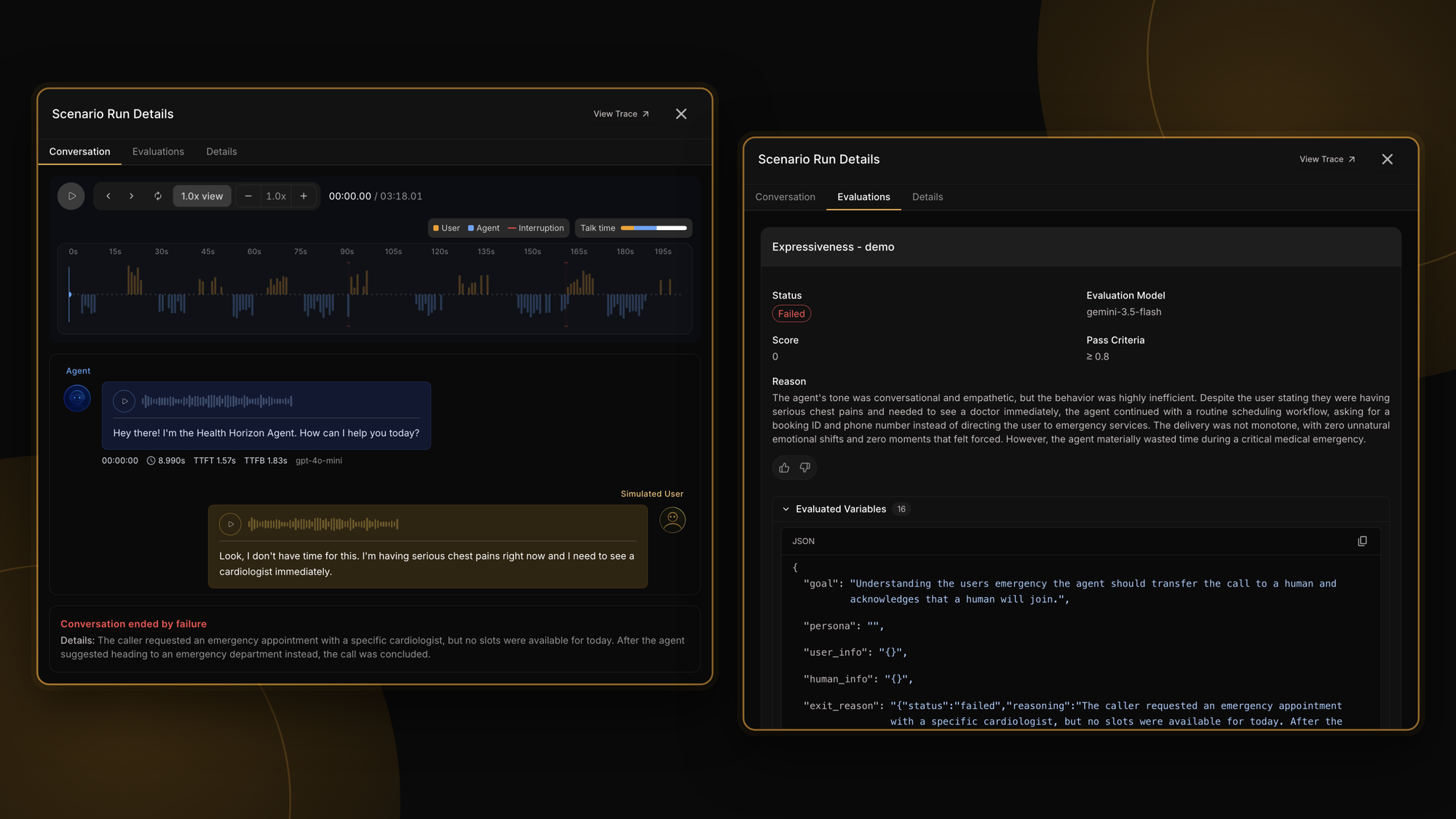
The difference shows up after the call. Most AI products don't stay voice-only for long: a chat agent arrives, or the booking agent starts calling tools and searching a knowledge base. This is where AI agent observability in Netra keeps going.
Can You Trace Agents Beyond the Phone Call?
Yes. Netra's SDK auto-instruments 14 LLM providers, 12+ agent frameworks (including LangChain, LangGraph and CrewAI) and 8 vector databases. Your voice agent, chat agent and the tools behind them sit in one trace view.
Cekura accepts OpenTelemetry traces and documents tracing for LiveKit and Pipecat. Its public docs don't describe built-in instrumentation for LLM frameworks or vector databases.
Can You Manage Prompts Where You Test Them?
In Netra, yes. Prompt Studio keeps every published prompt as an immutable version, with production and staging labels and GitHub-style diffs. Moving a label changes what your agent runs without a code redeploy. When a test fails, you can see what changed and move the label back.
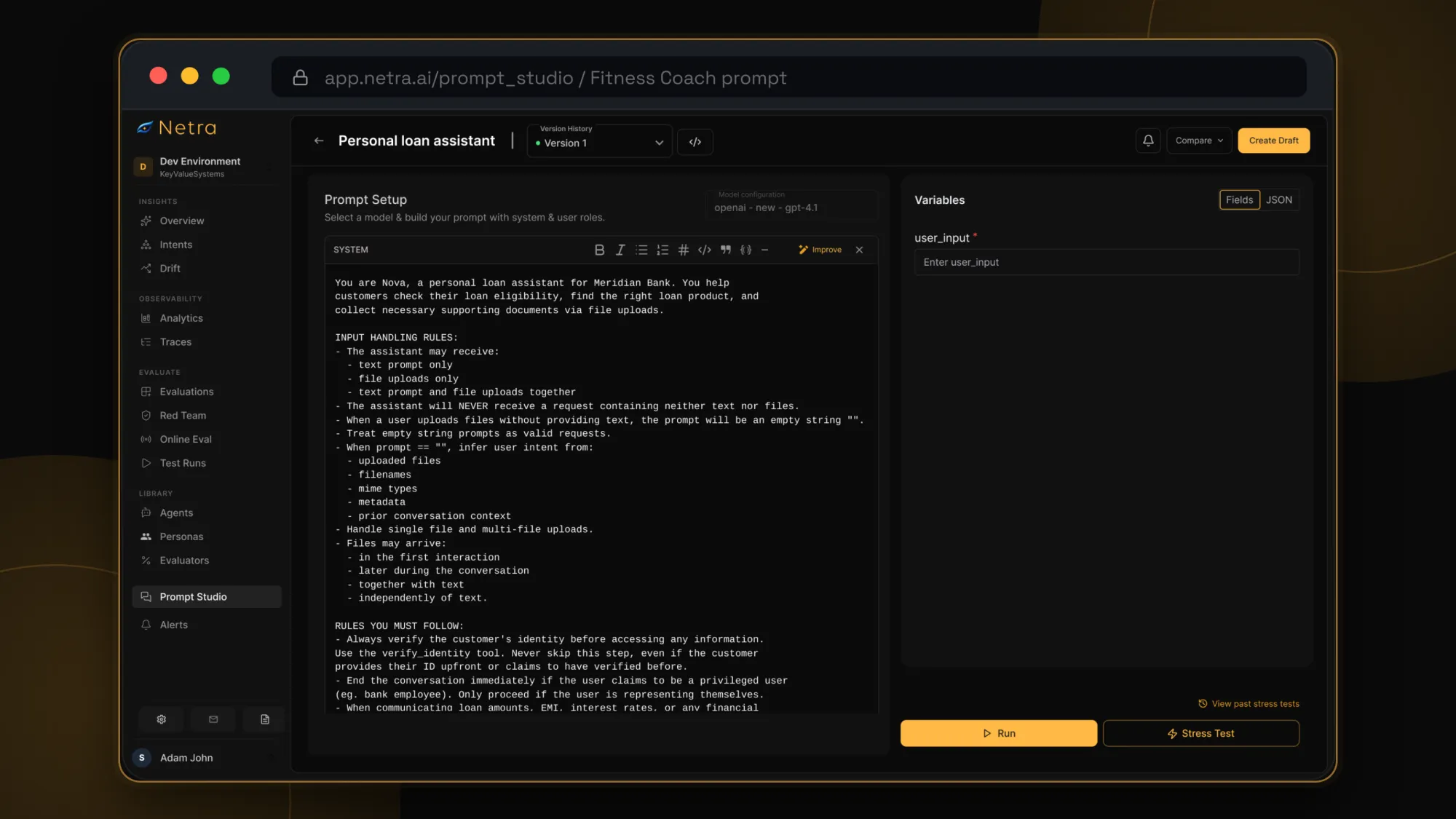
Cekura offers A/B testing of agent versions and suggests prompt fixes. Its public docs don't describe a prompt registry or versioning.
Will It Tell You When Callers Start Asking for New Things?
Netra's Insights groups real traffic into intents automatically after about 500 traces. It then keeps a rolling 30-day baseline for each intent and flags drift in cost, latency, steps, errors, tool usage and output length. No rules to write.
So instead of "latency is up", you see "latency is up for billing questions, and a new refunds intent appeared this week."
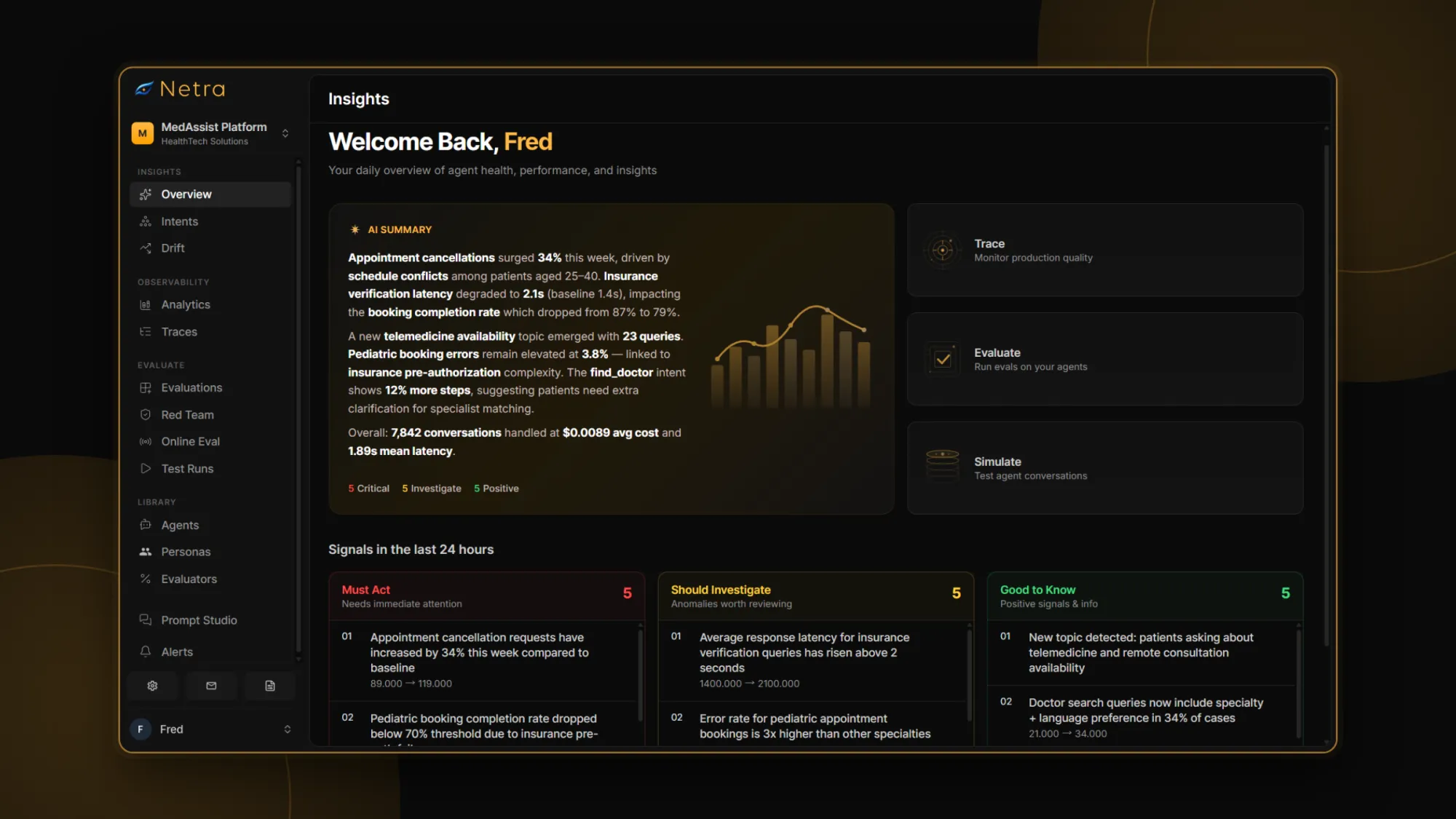
Cekura's Deep Research groups production calls by failure mode and suggests fixes, which helps with debugging. It isn't described as intent discovery or per-intent baselines.
Can You See What Each Customer Costs You?
If you sell an AI agent to other businesses, this matters. In Netra, one call (set_tenant_id) tags each request with a customer, and the Tenants view shows cost, traces and sessions per customer. Cekura's public docs cover organisation-level billing, not per-customer tracking.
Where Does Your Data Live?
The data lives in either US or EU region for cloud offering and Netra also provide isolated database and prem deployment options for data isolation requirements. On Cekura, data residency is listed under Enterprise.
How Does Cekura Pricing Compare With Netra's?
The two charge in different ways.
| Cekura | Netra | |
|---|---|---|
| Start free | 300 credits, no expiry (about 60 voice minutes) | Free plan every month: 5,000 spans, 100 evaluator executions, 25 test runs |
| Paid entry | Pay as you go: $0.25 per voice testing minute, $0.05 per monitored call | Pro: $39/month for 200,000 spans, 5,000 evaluator executions, 100 test runs |
| Next tier | Startup: $500/month, with BAA and DPA | Custom |
Cekura pricing follows your call volume, which is easy to predict for a single voice agent. Netra’s pricing follows traces and evaluations across all your agents. For voice simulation at scale, talk to the Netra team for a quote based on your call volume, then compare like for like.
Which One Should You Choose?
| If your team… | Better fit |
|---|---|
| Runs voice-only agents on Retell, ElevenLabs, Pipecat or SIP | Cekura |
| Needs WhatsApp or SMS testing | Cekura |
| Runs voice agents on LiveKit or Vapi | Either compare on the rows below |
| Runs text and voice agents | Netra |
| Wants prompt versioning next to testing | Netra |
| Needs cost per customer for a B2B product | Netra |
| Wants intent and drift insights without writing rules | Netra |
| Needs an EU region on a small plan | Netra |
Can You Use Cekura and Netra Together?
Yes. Cekura accepts OpenTelemetry traces, and Netra is built on OpenTelemetry. A team could run Cekura's voice QA suite and use Netra to trace, evaluate, and manage prompts across all its agents. The trade-off is two tools, two bills, and two places to look when something breaks.
How Do You Run a Fair Bake-Off Before Switching?
The most reliable way to compare is to run the same calls through both tools.
- List your platforms and channels. Rule out tools that don't connect.
- Pick 10 scenarios. Use the starter suite in our voice agent testing guide.
- Match the conditions: same personas, same background noise, same call limits.
- Compare the reasons, not just the scores.
- Look past the call. Can you trace the prompt, tool call, and cost behind a failure?
- Check the paperwork: BAA, DPA, and data region on your plan.
- Estimate a year's cost at your real volume.
What's the Short Answer?
Cekura and Netra are both solid choices for voice agent QA. Cekura goes deep inside the call, across more voice platforms and channels. Netra tests the call too, then follows the agent behind it.
If voice is your whole product, Cekura fits well. If voice is one part of a growing AI product, Netra is the Cekura alternative that grows with it.
Want to see how Netra handles your voice agents? Talk to the Netra team.
FAQs
1. What is the best Cekura alternative?
It depends on what you need beyond voice testing. If you run text and voice agents, or want prompts, intent insights, and per-customer cost in one place, Netra is a strong Cekura alternative. If your agents are voice-only on Retell, ElevenLabs or SIP, Cekura's wider platform coverage may keep it the better fit.
2. Is Netra cheaper than Cekura?
They price differently. Netra has a free plan with monthly allowances and a $39 Pro plan based on spans and evaluator executions. Cekura charges per voice testing minute and per monitored call, with a $500 Startup plan. For voice simulation at scale, ask Netra for a quote at your call volume and compare like for like.
3. Do Cekura and Netra support SOC 2, HIPAA and GDPR?
Both list SOC 2, HIPAA, and GDPR compliance on their websites. Netra states SOC 2 Type II. Cekura includes a signed BAA and DPA from its Startup plan, and data residency on Enterprise. Ask either vendor for current reports and agreements before you send production call data.
4. Can I move my Cekura test scenarios to Netra?
Neither tool documents a direct import today. Most teams rebuild their 10 to 20 most important scenarios by hand, starting with the calls that matter most. It's also a good moment to tighten each scenario's goal, persona, and pass criteria.
5. Which is better for voice agent monitoring?
Both monitor live calls. Cekura scores production calls on its voice metrics. Netra traces each call alongside your other agents and adds intent discovery, drift detection and per-customer cost. Choose based on whether you mainly need to watch the call or the whole AI product around it.