
Library of pre-built evaluators
Faithfulness, answer relevance, tool-choice correctness, JSON schema validity, toxicity, PII leakage, tone, format compliance
Improve
Featured cookbooks
Company
EVALUATIONS
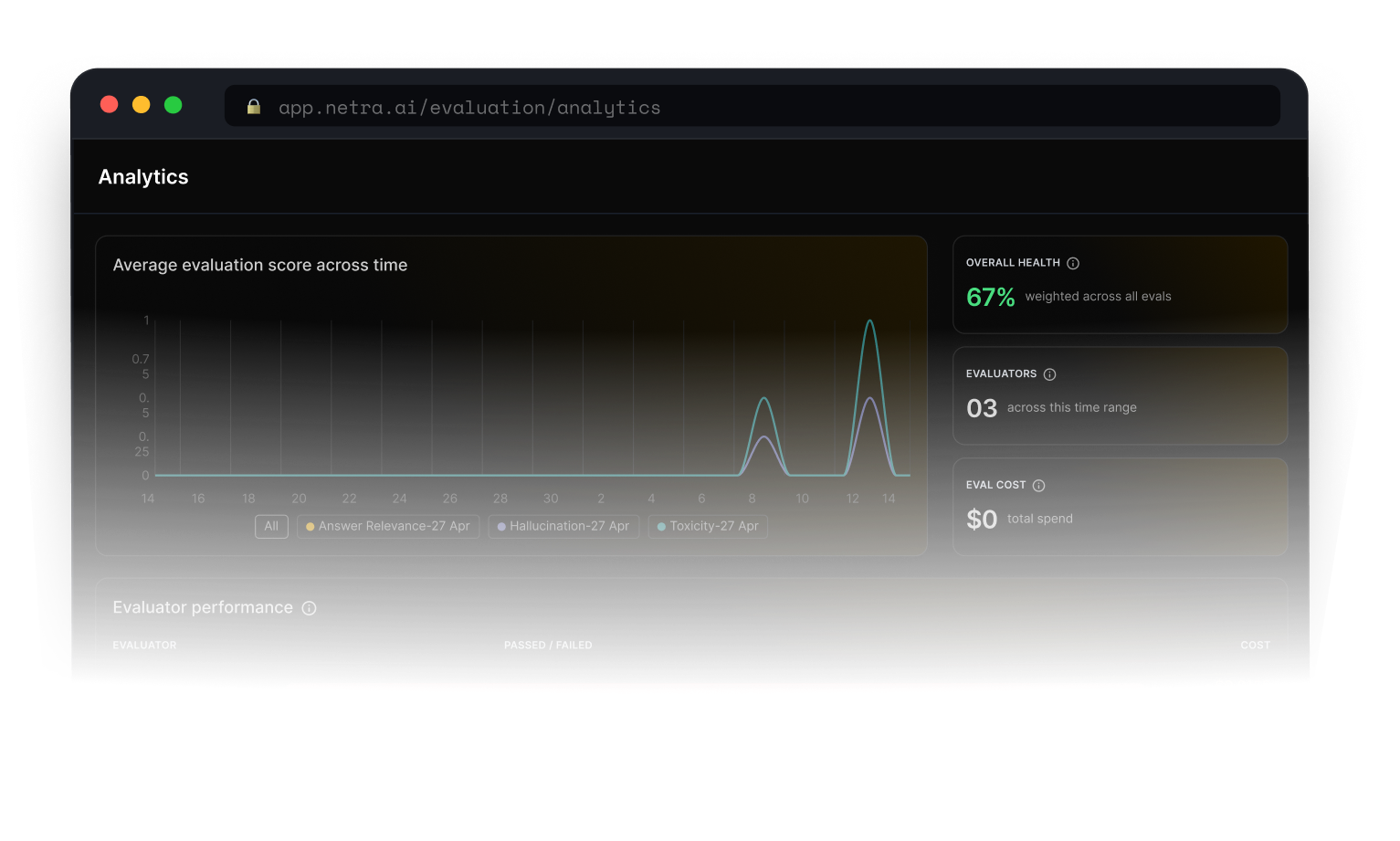
Run pre-built or custom evaluators against test datasets, experiment runs, or live production traffic — and grade every change before it ships and every response after it does.
Deep dive
"It worked in testing" is how compliance violations, hallucinated refunds, and 3 a.m. pages happen. Most teams catch issues only after a user complains — because they have no systematic way to grade quality.
Netra makes evaluation a first-class step in your development loop. Define what good looks like for your agent — faithfulness to retrieved context, correct tool selection, valid JSON, on-policy tone, no leaked PII — then grade every change against it. Pick from our evaluator library, or write a custom one in Python and run it on the same infrastructure.
Run evaluations three ways: on datasets for offline regression testing before you ship, on experiment runs to compare two prompt versions head-to-head, and on live production traces to catch quality drops the moment they happen. Convert any cluster of production failures into a dataset in one click — your test set evolves with reality, not against it.
When a judge gives a verdict, you can inspect why: every LLM-as-judge execution is itself traced, so you see the exact prompt the judge received and the reasoning it returned. Trust the scores, debug the bad ones, and audit the whole chain for compliance.
Capabilities
Faithfulness, answer relevance, tool-choice correctness, JSON schema validity, toxicity, PII leakage, tone, format compliance
LLM-as-judge, deterministic / statistical, and human-in-the-loop
Bring your own logic, wired into the same pipeline
Session, trace, or span — score whole conversations or single tool calls
Compare prompt v1 vs v2 across thousands of cases, see win/loss/tie
Curate real failures into golden test sets, no synthetic data drift
Score live traffic as it flows, surface regressions in minutes
Every judge run is itself traced, so you can audit and trust the scoring
Get clear answers, fast — talk to our team and get tailored insights for your business in just a few minutes.
Yes — Auto-Evaluation runs Coherence, Factual Accuracy, and Toxicity on every incoming trace org-wide, until your configured usage limit.
Yes — via the Netra MCP server: browse and create evaluators, build datasets, and launch test runs directly from Cursor, Claude Code, Windsurf, and others.
Yes. A curated evaluator library across Quality, Multimodal, Guardrails, Performance, Semantic, and Agentic categories, each pre-configured with a pass threshold (for example Answer Relevance ≥0.7, Toxicity ≥0.5). One-click add, no setup.
Use the RAG-specific evaluators in the library — Context Precision, Context Recall, Context Relevance, Answer Correctness, Answer Relevance, Semantic Similarity, SQL Semantic Equivalence — or build a custom evaluator if none fit.
Defining the expected output for every possible input is not practical for multi-turn agents. Use Simulation instead — define a goal, persona, and facts, and Netra runs realistic multi-turn conversations and scores them automatically.
Online eval gives you live monitoring of user interactions and agent behavior as it happens — no synthetic data needed. Pull real production traces directly into a dataset and run evaluators against actual user interactions, closing the loop between what you tested and what is really happening in production.
Yes. Evaluations score quality on a dataset or trigger; Alerts monitor cost, latency, error rate, and anomalies in real time across all production traffic — so you are notified the moment something breaks, not just when you run an eval.
Yes. Two ways: LLM-as-Judge for subjective and semantic criteria such as correctness and relevance, or a Code Evaluator (JavaScript or Python) for deterministic checks like format validation, regex, and calculations.
Trusted by teams shipping agents in production
Start today
Free to start. No credit card.