
Automatic conversation clustering
Group sessions by user intent without manual tagging
Improve
Featured cookbooks
Company
AGENT INSIGHTS
Netra automatically clusters production sessions by intent, outcome, failure mode, and cost profile — so you fix systemic issues, not yesterday's bug report.
Deep dive
Scrolling traces one at a time is fine when you have ten. It's useless when you have ten million. By the time you've read a hundred, you've forgotten the first one — and you've still seen 0.001% of your traffic.
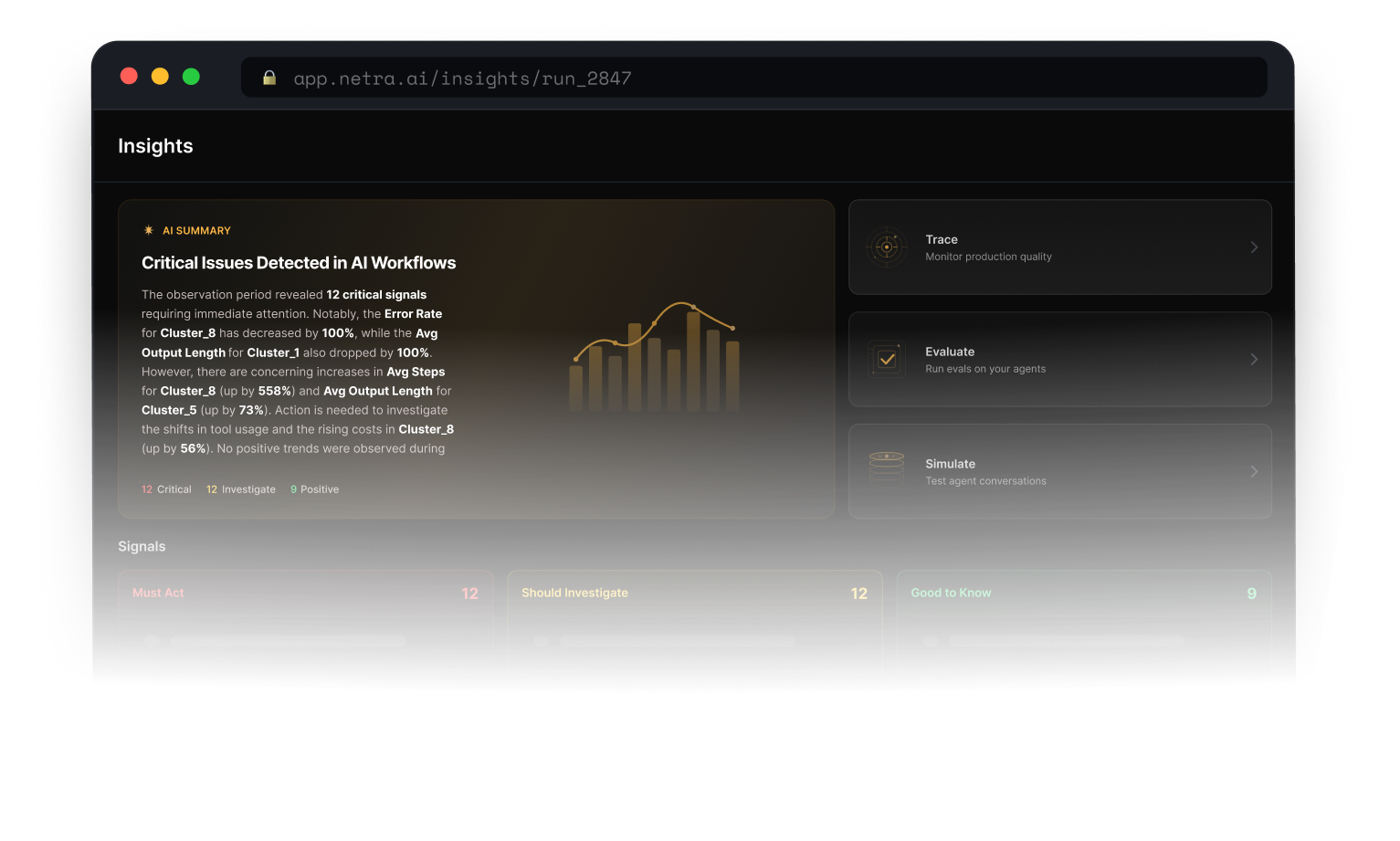
Agent Insights works the other direction: it looks at all your production sessions and tells you what's actually happening. Conversations are auto-clustered by intent and outcome — "refund requests, 23% of traffic, 87% success", "multi-turn troubleshooting, 11%, 64% success and rising cost", "off-topic chitchat, 4%, escalation rate climbing". No manual tagging, no taxonomy work.
Inside every cluster, Netra surfaces the failure modes: the same retrieval gap hit 12% of the time, the same tool entering a loop in 3% of sessions, the specific user phrasing that consistently bypasses your guardrails. Anomaly and drift detection run continuously — when a new failure pattern emerges or an old metric quietly degrades, you know before it becomes a ticket queue.
Ship a prompt change, and you see exactly which clusters got better, which got worse, and which entirely new behaviors emerged. Insights become hypotheses, hypotheses become evals, evals become regression tests. The loop closes.
Capabilities
Group sessions by user intent without manual tagging
Surface the top 10 recurring breakage patterns across millions of sessions
Sessions burning 10x average tokens, or scoring 2x worse, flagged automatically
Spot deviations in tool usage, latency, or quality the moment they emerge
Compare today's behavior to last week's, catch silent model and data drift
See which intents are growing, which are getting worse, which need new tools
Click any pattern, see the representative sessions in one click
When you ship a prompt change, see which clusters got better and which regressed
Trusted by teams shipping agents in production
Start today
Free to start. No credit card.