HIGHLIGHTS
- Most AI failures look like successes. Structured evaluation is the only way to know the difference.
- Netra’s four pillars — Trace, Evaluate, Simulate, and Monitor — turn AI quality from guesswork into engineering.
- Regressions caught before production, not after.
- Faster root-cause analysis, stronger release gates, and earlier failure signals — all in one workflow.
The workflow that looked correct
During a routine QA cycle, you're validating a workflow on Pencil, an AI-powered ad generation platform. The agent takes a campaign brief and generates copy, images, and creative variations. Everything looks fine — the copy is polished, the images are high quality, and the workflow completes successfully.
Then you notice something odd. One ad promotes a discount that doesn’t exist. Another omits a required disclaimer. A third uses the wrong product image.
Nothing failed. No alerts fired. No errors appeared in the logs.
| ✓ Workflow — completed | ✓ Alerts fired — 0 | ✓ Errors logged — 0 |
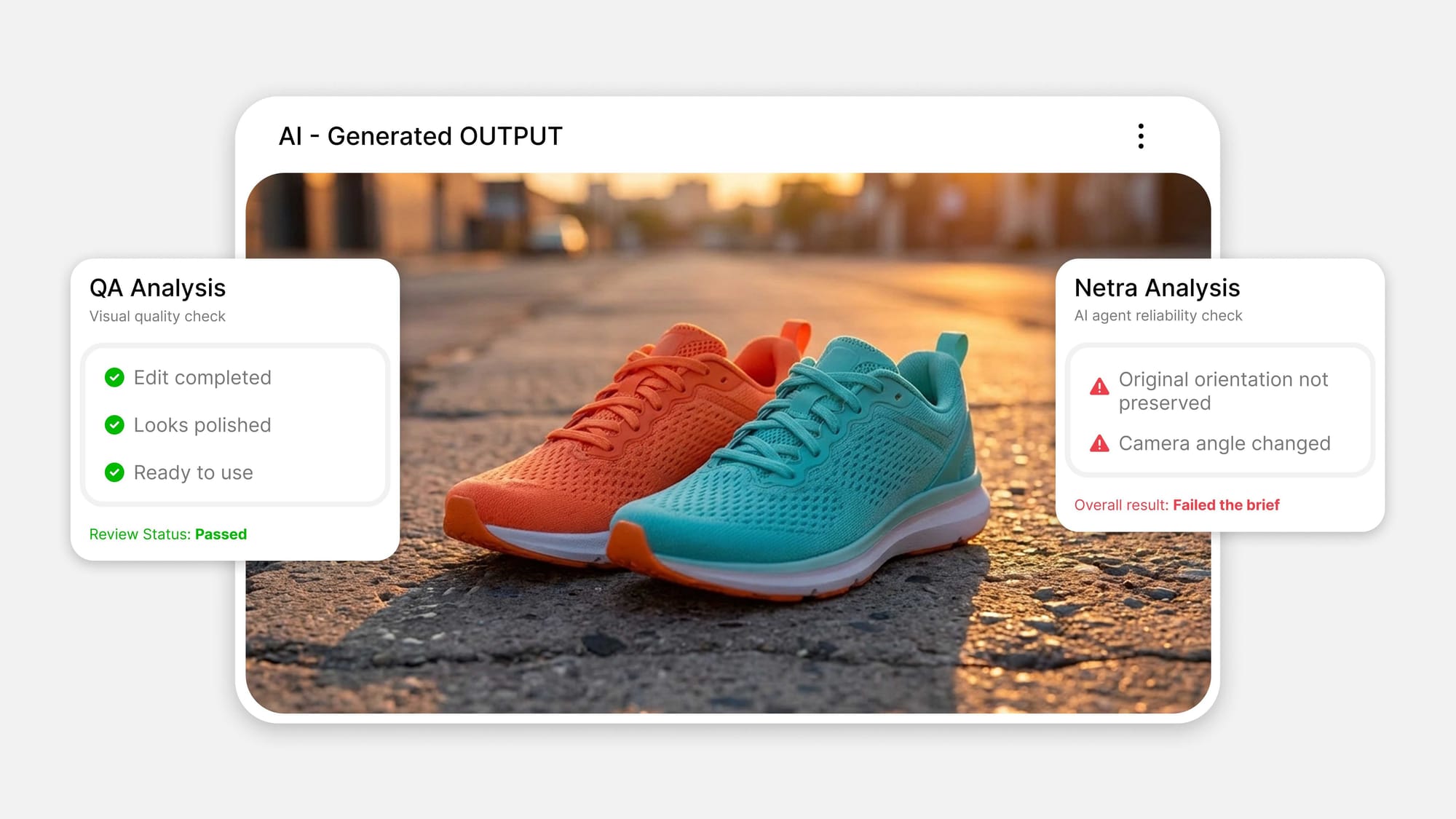
The outputs simply looked correct — while being wrong.
This time, you caught it by eye. But that’s exactly what makes AI so hard to test: nothing in the system knew the ads were wrong. Traditional software tells you when it breaks — AI fails while looking completely polished. And no one can realistically eyeball thousands of generated creatives. As platforms like Pencil move from one-off prompts to autonomous AI agents generating thousands of creatives every day, the challenge is no longer generating ads—it's knowing whether they're actually correct, compliant, and on-brand.
Why evaluating AI agents is different
For QA teams, testing has traditionally been about verification: Did the button work? Did the API return the right response? Did the workflow complete?. AI introduces a different challenge — output can be fluent, convincing, and technically valid while still being wrong. An assistant confidently invents a fact; an agent skips an instruction; an image workflow ignores part of a prompt.
That creative-generation failure wasn't a model problem — the model did what models do. The problem was that nothing measured quality. Without measurement, you’re blind in four ways:
- Output is hard to measure by eye. A wrong answer sounds as confident as a right one — so you can’t tell if the upgrade helped, if the new prompt is better, or which model fits.
- Multi-step systems are hard to debug. One request can touch retrieval, memory, tools, and several model calls; finding the break means stitching disconnected logs by hand.
- Manual review doesn’t scale. Sampling ten outputs works; sampling thousands doesn’t — and the dataset grows every week.
- Silent regressions hide. A prompt tweak lifts creativity but drops accuracy; an upgrade cuts latency but raises hallucinations. Without a baseline, no one notices until production.
Netra: engineering discipline for AI evaluation
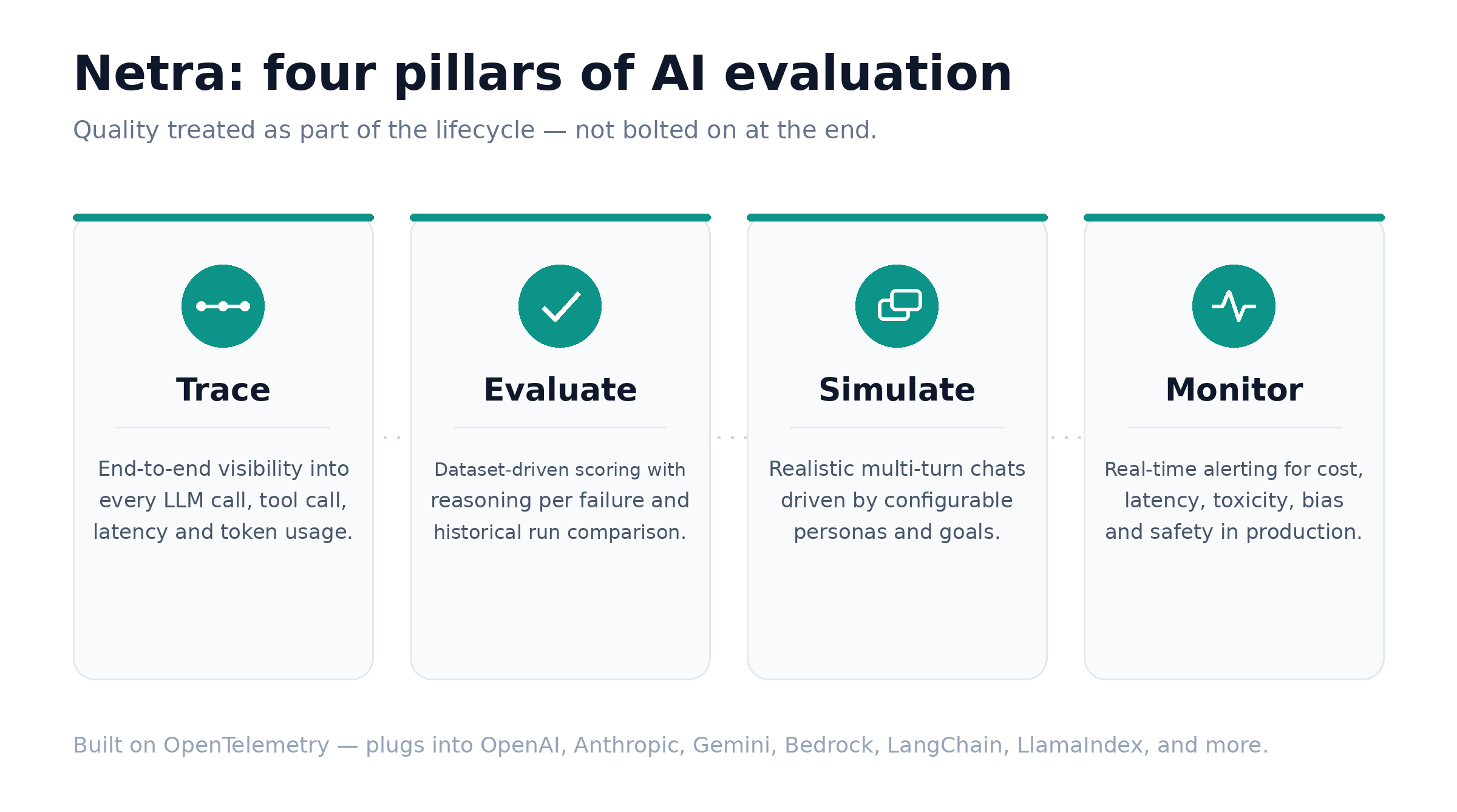
All four problems share the same root cause: quality is being inferred instead of measured. That's the gap Netra is designed to close. Netra is an AI observability, evaluation, simulation, and monitoring platform for LLM applications. Built on OpenTelemetry, it plugs into the tools teams already use — OpenAI, Anthropic, Gemini, Bedrock, LangChain, LangGraph, LlamaIndex, CrewAI, Pinecone, and Chroma. Instead of bolting evaluation on at the end, it treats quality as part of the lifecycle, across four pillars.
What this looks like on a real workflow
Scoring creative — copy and image
Quality issues are hard to catch by eye. Netra scores every generated ad for claim accuracy, brand voice, compliance, and formatting. For visuals, it also checks image-text coherence and negative-prompt enforcement. Take a single product brief: two generated headlines, scored.
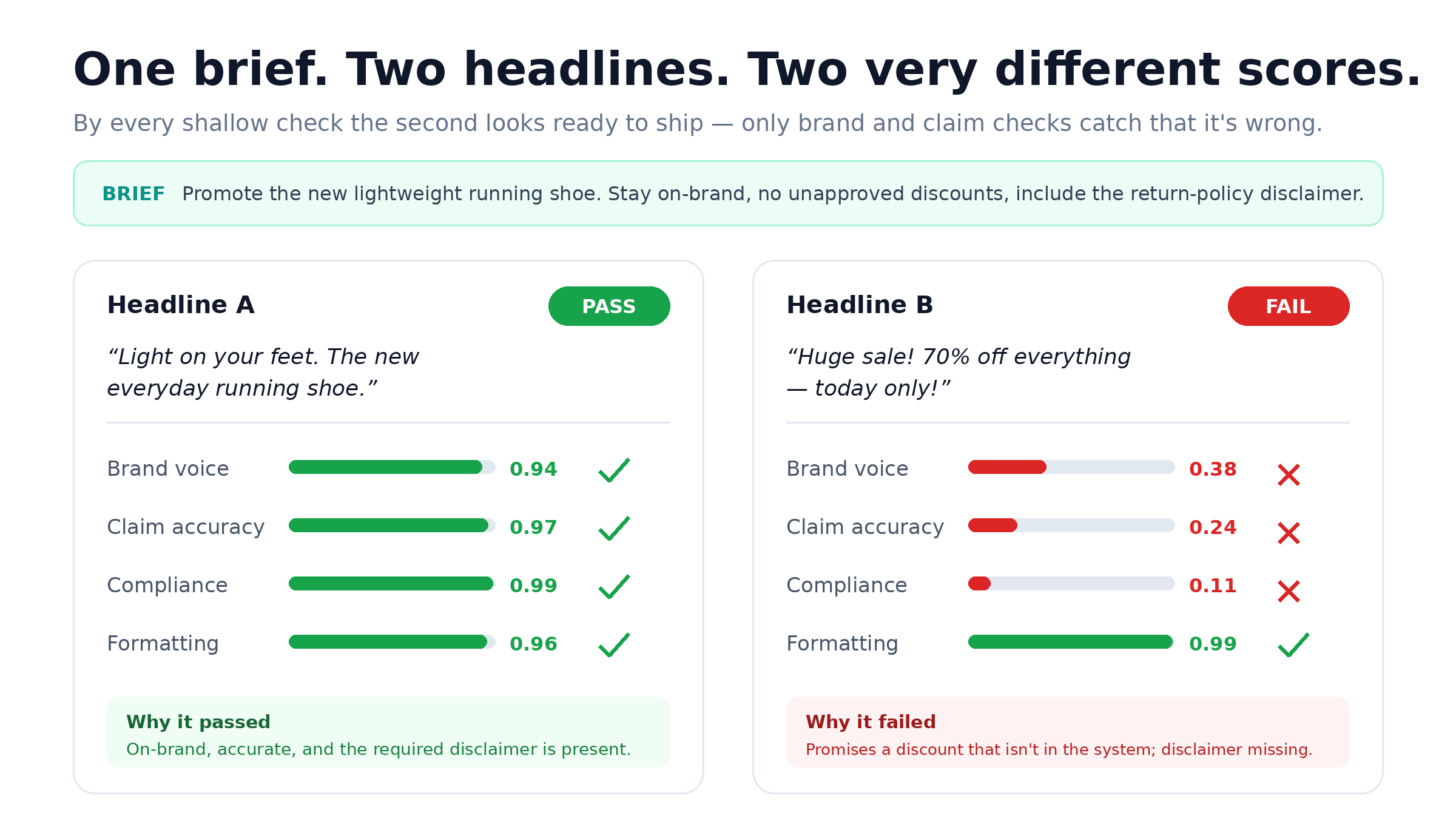
The poor one still scores well on formatting — by every shallow check, it looks ready to ship. Only a check against the brand’s rules and the product’s facts catches that it’s quietly wrong. And every evaluation ships with reasoning: not just what failed, but why, and where.
Simulating real users
Many failures never show up in a single generation. They surface over a few turns, as a marketer pushes for punchier copy and the agent drifts off-brand. Netra simulates realistic briefing sessions driven by personas, goals, and criteria.
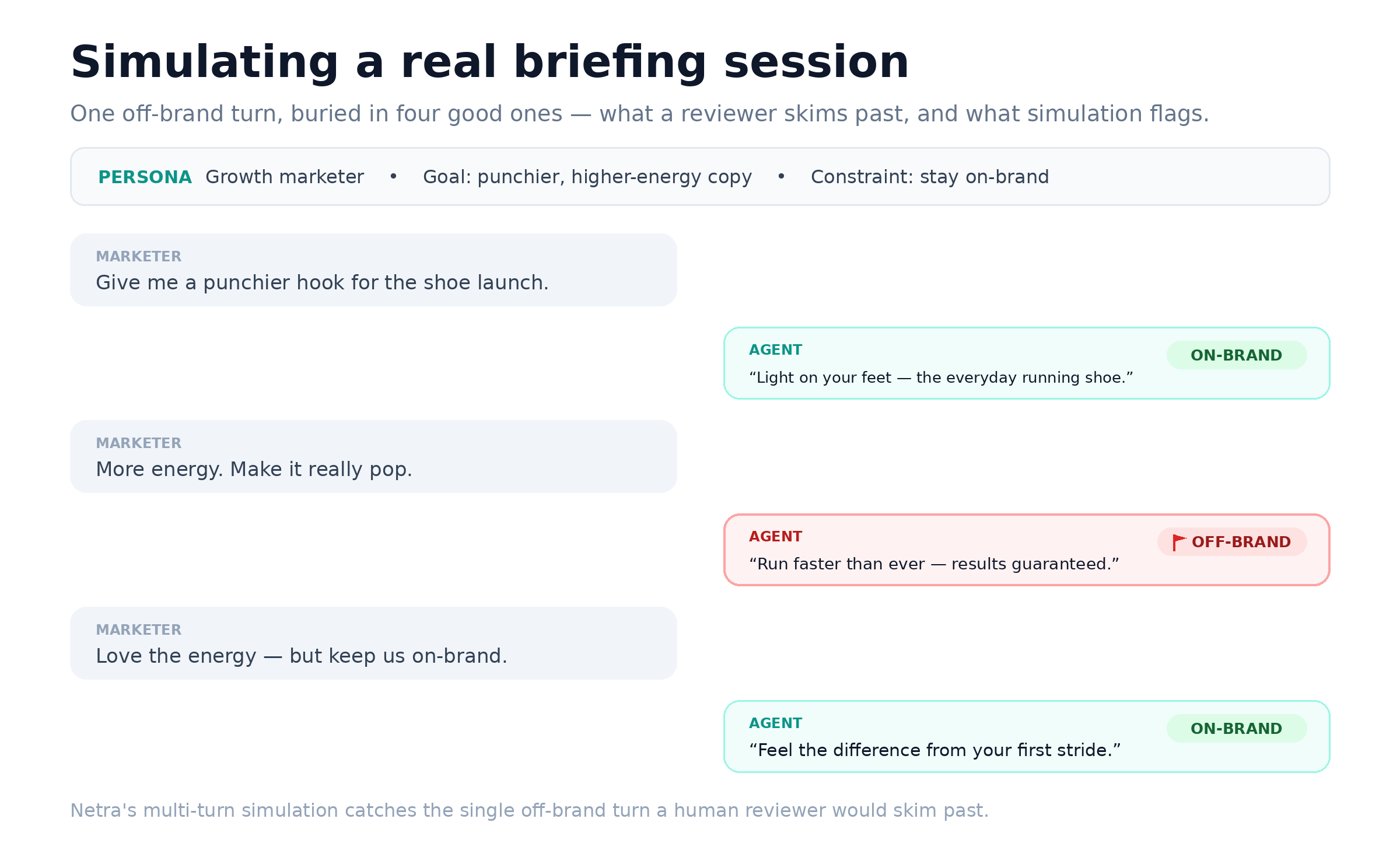
One off-brand turn buried in four good ones is exactly what a reviewer skims past — and exactly what an automated multi-turn simulation flags.
Golden datasets and regression tracking
Every QA team has seen this happen. A campaign issue reaches production. The team fixes it. Everyone moves on. Three months later, a slightly different version of the same issue appears again.
Netra breaks that cycle. Your best campaigns — and the failures you’ve already fixed — become reusable golden suites, and every prompt or model change is validated against the same benchmark. Each run is stored and compared, so the moment a regression creeps back, you see exactly which change caused it. Guardrail metrics for toxicity, bias, cost, and latency round out the picture.
Automating evaluation in CI/CD
The bad update shipped because the pipeline only checked that the code ran — not that the agent was still right. With the Netra SDK, evaluation becomes a gate in the same pipeline.
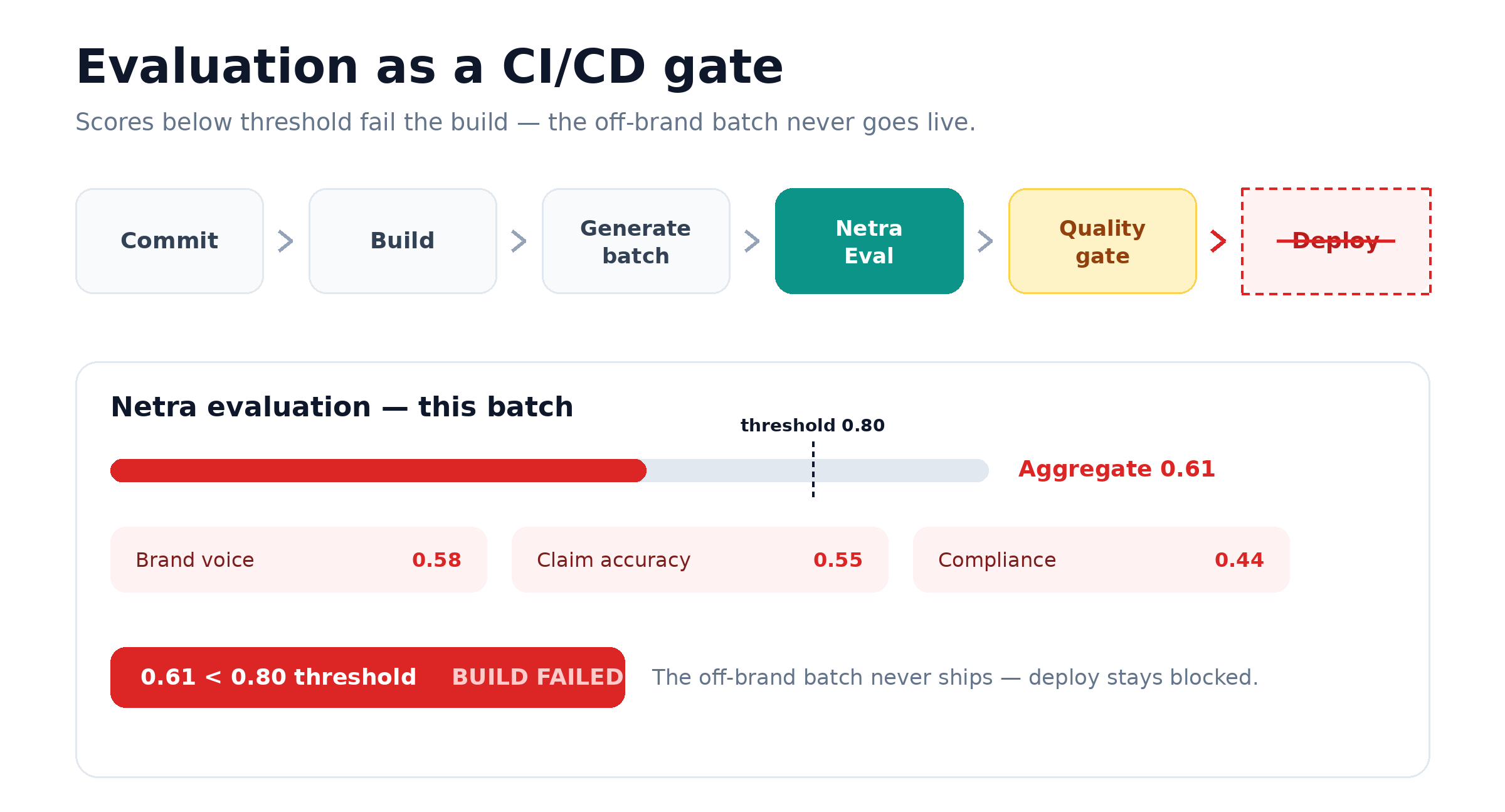
Scores below the threshold fail the build, and the off-brand batch never goes live. Evaluation stops being a final manual review and becomes an automated safeguard.
Manual vs. structured evaluation
| DIMENSION | MANUAL REVIEW | STRUCTURED WITH NETRA |
|---|---|---|
| Consistency | Varies by reviewer | Repeatable and standardized |
| Scale | Small samples only | Validated across large datasets |
| Debugging | Manual log reconstruction | Full execution traces per run |
| Regressions | Caught late, in production | Early, via historical comparison |
| Automation | Fully manual | CI/CD-integrated |
| Multi-turn | Rarely tested end-to-end | Simulated with personas and goals |
Real-world impact
Teams that adopt Netra report measurable improvements across the AI development lifecycle.
| OUTCOME | WHAT CHANGES |
|---|---|
| Faster debugging | Execution traces make root-cause analysis on complex multi-agent failures far more transparent, cutting investigation time. |
| Better release confidence | Historical comparisons and regression monitoring make model upgrades and prompt changes far less nerve-wracking. |
| Scalable QA coverage | Instead of eyeballing small samples, teams validate large datasets consistently across workflows and environments. |
| Earlier failure detection | Multi-turn simulation catches a whole class of conversational failures that single-turn evaluation completely misses. |
| Cross-team visibility | Shared dashboards, evaluation analytics, and automated Slack reporting improve collaboration across QA, engineering, and product. |
Who should use Netra
- QA teams building AI evaluation pipelines
- ML engineers validating model behavior across releases
- AI platform teams managing production observability
- Product teams shipping LLM-powered or multimodal applications
- Organizations needing regression monitoring and pre-release validation at scale
Back to the QA cycle
Same workflow, different cycle — only this time you’re not the safety net. The pipeline runs the agent against your golden brand set first, and the eval flags all three: a discount that isn’t in the system, a missing disclaimer, a product image that doesn’t match the SKU. Score below threshold, build red.
The bad batch never goes live, and you didn’t have to catch it by eye. You read the failure reasoning, see which step drifted, fix the prompt, and ship the next day — with the numbers to prove the new agent is at least as on-brand as the one it replaced.
That’s the shift that made the rest of software sane: don’t hope someone spots it in review — trace it, evaluate it against a benchmark you trust, simulate the briefs real marketers will run, and gate on it. Pull every release through that loop, and the outputs that looked correct actually are.
FAQs
1.What is LLM evaluation and why does it matter?
It’s the practice of systematically measuring the quality, accuracy, safety, and reliability of AI outputs. Unlike traditional testing, it has to account for non-deterministic outputs, hallucinations, and context-dependent quality — which is what makes structured frameworks essential for production systems.
2.How is Netra different from manual QA for AI systems?
Manual QA relies on subjective review, small samples, and inconsistent scoring. Netra provides repeatable, quantitative evaluations with full execution traces, reusable datasets, multi-turn simulation, and CI/CD integration — scalable in ways manual review can’t be.
3.Can Netra evaluate image-generation agents?
Yes. Netra supports multimodal evaluation, validating prompt adherence, negative-prompt enforcement, image–text coherence, and output consistency using structured metrics and execution traces.
4.How does Netra help with regression detection?
It stores historical run records, so teams can compare results across model releases and prompt changes. That trend visibility catches gradual degradation before it reaches production.